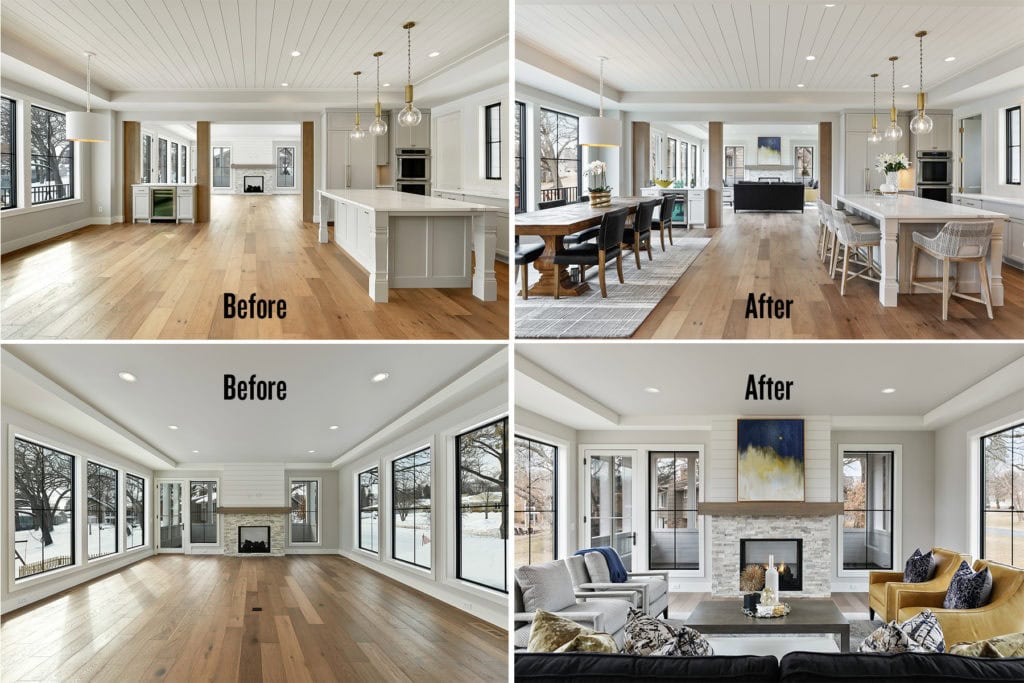
Every seller asks some version of the same question before listing: is it actually worth staging my house, or is that money better spent somewhere else? It’s a fair question, especially when a professional staging job can run into the thousands of dollars, and when half the advice online comes from staging companies with an obvious reason to say yes. So I pulled the latest numbers — from the National Association of Realtors, independent staging researchers, and our own Turlock market data — to give you a real, sourced answer instead of a sales pitch.
Short version: does home staging increase sale price? For most homes, yes — but not by a fixed, guaranteed number, and not equally in every market. The size of the bump depends on your price point, how much work the home needs, and how competitive your local market already is. The rest of this post breaks down exactly how much, what it costs, when it’s worth skipping, and what it means specifically if you’re selling in Turlock or the Central Valley right now.
(Insert Table of Contents block here)
What the Data Actually Says About Home Staging and Sale Price
Let’s start with the most current, credible source available: the National Association of Realtors’ 2025 Profile of Home Staging, the backbone of most reliable home staging statistics 2026 sellers actually see referenced. NAR surveys thousands of real estate agents every year specifically about staging outcomes, which makes it one of the few large-sample, non-biased sources in this space (staging companies publish their own stats too, but they have an obvious incentive to round up).
Here’s what NAR’s agents reported. Twenty-nine percent said staged homes received offers 1% to 10% higher in dollar value than they would have unstaged. Separately, 17% of buyer’s agents said staging led to a 1% to 5% increase specifically in the offer price their clients submitted. Those are two different angles on the same trend, and they both point in the same direction: staging tends to push offers up, even if the exact percentage varies by home and market.
Taken together, these numbers are the clearest direct evidence that home staging increases sale price is more than just a rule of thumb agents repeat. It shows up consistently in the data agents report every year.
The bigger number, though, might be this one: 83% of buyer’s agents said staging made it noticeably easier for their clients to picture themselves living in the home. Another 60% said staging affects some buyers, and 26% said it affects most buyers. Put simply, staging isn’t really about tricking anyone — it’s about removing the mental friction of imagining your own life in someone else’s space.
So does home staging increase sale price because of some psychological trick, or because it genuinely photographs and shows better? The data suggests it’s mostly the latter — a well-staged home simply presents more clearly, both online and in person, which naturally invites stronger offers. That’s ultimately the mechanism behind why home staging increases sale price so consistently across studies: it’s not about buyers being fooled, it’s about buyers acting faster and more confidently on a home they can already picture living in.
Why Staging Actually Works: The Psychology Behind the Numbers
It helps to understand why staging moves the numbers at all, because it makes it easier to decide whether it’s worth it for your specific home. Buyers aren’t just evaluating square footage and finishes — they’re trying to answer one question as they walk through: could I see myself living here?
A cluttered closet, a wall of family photos, or a room stuffed with mismatched furniture all make that mental leap harder. The buyer’s brain gets distracted cataloguing your stuff instead of imagining their life in the space. That’s the real reason 83% of buyer’s agents told NAR that staging helped their clients visualize the home — it’s not decoration, it’s removing friction.
This also explains why staging helps sell a house faster than an identical unstaged listing: buyers who can picture themselves living somewhere tend to act on that feeling quickly, especially in a market where good listings don’t sit around long. Photos matter here too — most buyers form their first impression online, long before they ever request a showing, so a home that photographs well gets more of the right showings in the first place.
How Much Does Home Staging Really Cost in 2026?
This is where a lot of sellers get sticker shock, so let’s be upfront about it. According to HomeGuide’s 2026 cost data, the cost of home staging for an entire home typically runs $1,500 to $4,000 for the first month, with additional months costing $150 to $1,200 depending on how much furniture is rented. Staging a single room usually runs $300 to $700.
Professional home staging cost varies quite a bit depending on whether the home is occupied or vacant, which is worth understanding before you budget for it. NAR’s own survey backs this up on the lower end too: the median cost when a seller hires a dedicated staging service was $1,500, while the median cost when the listing agent handled staging themselves (often just rearranging and decluttering) was closer to $500.
That gap matters. A lot of the value in staging doesn’t come from renting a truckload of new furniture — it comes from editing what’s already there. I’ll get into DIY options further down, because for a lot of Turlock sellers, that $500 version is genuinely enough.
Whichever route you choose, the underlying question is still: does home staging increase sale price enough to justify that budget — and for most homes, based on the numbers above, the answer is yes.
Staging vs. Not Staging: A Side-by-Side Look at the Numbers
Here’s where staging vs not staging gets interesting, because the studies don’t all agree on the magnitude — only on the direction. The Zebra’s 2026 staging research found that staged homes sold for an average of 25% more than comparable unstaged listings, and that 85% of staged homes sold somewhere between 5% and 23% above their original list price.
That’s a more aggressive number than NAR’s 1–10% range, and it’s worth being honest about why: different studies measure different things — some compare sale price to list price, others compare it to what the home would have sold for unstaged, which is inherently an estimate. HomeGuide cites the International Association of Home Staging Professionals putting staged homes at 6% to 12% above list price on average, with some reaching 20% above.
So which number is “true”? Realistically, the honest answer is that home staging ROI lands somewhere in a range, not at one precise figure, and it depends heavily on the home, the price point, and how competitive your local market already is. What every source agrees on is the direction: staged homes consistently outperform unstaged ones, typically by mid-single-digit to low-double-digit percentages.
If you’re trying to settle the does home staging increase sale price debate for your own listing, the safest read of the combined data is this: expect somewhere in the 3–10% range for a typical home, with the higher end reserved for homes that needed the most visual help to begin with.
On a median-priced Turlock home right now — more on that below — even the conservative end of that range is real money on the table. And that home staging ROI percentage compounds with location: the more competitive the market, the more a well-presented listing stands out against the alternatives buyers are cross-shopping.
Does Staging Help Homes Sell Faster, Too?
Sale price isn’t the only thing on the line — time on market matters too, especially if you’re trying to coordinate a move or avoid carrying two mortgages. NAR’s sellers’ agents reported that 49% saw a reduction in time on market after staging: 30% called it a slight decrease, and 19% called it significant.
Other sources go further. The Zebra reports that staged homes sell faster by a wide margin, and HomeGuide notes that roughly 48% of staged homes spent less time on the market than comparable unstaged listings. Again, the exact percentage swings by source, but the pattern holds: buyers respond faster to a home they can immediately picture themselves in.
Fewer days on market usually means fewer price reductions too, which brings its own financial benefit beyond just the staging itself — something I’ll come back to later in this post. It’s another angle on whether home staging increases sale price and how quickly it gets there: a faster sale generally means fewer chances for a price cut to creep into the picture.
Occupied Staging vs. Vacant Staging: What It Costs and Why It Matters
Not every home needs the same approach, and this is where cost estimates online can be misleading if you don’t know which category your home falls into.
Occupied home staging — using your existing furniture, rearranged and edited by a stager — typically runs $1,000 to $3,000. It’s the more affordable route and works well as long as your current furniture is in decent shape and reasonably neutral in style.
Vacant home staging cost is a different story, because it usually requires renting furniture, which can run $3,000 to $6,000 or more, largely driven by monthly rental fees on sofas, beds, and dining sets. This route tends to make sense for investment properties, new construction, or homes where the seller has already moved out.
If your budget is tight, occupied staging (or a hybrid — keep your furniture, add a few rented statement pieces) usually gets you most of the benefit at a fraction of the cost of a full vacant staging package. In both cases, the goal is the same: does home staging increase sale price enough to offset what you spend on it, and for occupied staging in particular, the math is almost always in your favor.
Staging in a Seller’s Market: Does It Still Matter for Turlock Sellers?
Here’s the question I get most from Turlock clients: “If it’s already a seller’s market, do I even need to bother staging?” It’s a reasonable instinct, but the data says the answer is still yes — and I’d argue it matters more, not less, in a competitive market like ours.
As of June 2026, Turlock’s median home sale price sits at $484,736, with homes going under contract in a median of just 13 days. Redfin currently rates Turlock a “very competitive” market with a Compete Score of 86 out of 100 — 44.1% of homes are selling above list price, and the average sale-to-list ratio is running at 99.5%.
In a market moving that fast, staging isn’t about attracting a buyer where there wasn’t one — it’s about winning the multiple-offer situation once buyers are already through the door. When 44% of homes are already selling above asking, a staged home is the one more likely to be in that group, not the one settling for list price or below.
Locally, this is really where home staging increases sale price stops being a theoretical question and becomes a practical one: in a 13-day median market, you generally get one real shot at first impressions before offers are already due.
If you’re weighing home staging in Turlock CA against other prep for your listing, my guide to selling a home in Turlock walks through the full pre-listing checklist, and it’s worth reading alongside this post. I also keep an eye on shifts in the Turlock real estate market on the blog if you want ongoing context beyond this one snapshot.
When Staging Might Not Be Worth the Investment
I’d be doing you a disservice if I said staging is always the right call, because it isn’t. NAR’s own data shows that 51% of sellers’ agents actually recommend decluttering over full, formal staging — and in a lot of cases, that’s the smarter, cheaper move.
Does staging help sell a house more than a thorough decluttering and deep clean would? Sometimes the gap is smaller than staging companies want you to believe. Brand-new construction that already shows well, homes with genuinely excellent existing furniture and neutral décor, and ultra-low-inventory micro-markets where buyers have almost no other options are all situations where a full staging budget may not move the needle much.
The honest litmus test I use with clients: if your home is cluttered, over-personalized, or hard to photograph well as-is, staging (even a light version) is almost always worth it. If it already shows like a model home, you may only need a stylist’s eye for a few hours rather than a full furniture package. Even here, does home staging increase sale price is still the right lens to use — it’s just that for these homes, the expected increase may not clear the cost of a full staging package.
I’ve walked plenty of Turlock listings where the seller was ready to spend $3,000+ on a vacant staging package, and the home just didn’t need it — a weekend of decluttering, a fresh coat of paint on one accent wall, and better lighting got 90% of the visual impact for a fraction of the cost. On the flip side, I’ve seen dated, heavily personalized homes sit for weeks until staging (or at least a serious depersonalizing pass) finally got buyers through the door and writing offers.
DIY Staging Tips That Cost (Almost) Nothing
If a full staging budget isn’t in the cards, or you just want to do the free version first, here’s where to focus your energy before spending a dollar. None of this costs much, and it targets the same underlying question — does home staging increase sale price — just through free or low-cost effort instead of a paid package:
- Declutter aggressively. Clear countertops, closets, and surfaces to roughly a third of what’s currently there — buyers open closets and cabinets, and a packed one reads as “not enough storage.”
- Depersonalize. Family photos, kids’ artwork, and strong personal collections make it harder for buyers to picture their own life in the home.
- Deep clean everything. Grout, baseboards, windows, and appliances — a spotless home reads as well-maintained even before a buyer notices the layout.
- Fix the lighting. Open every blind, replace dim or mismatched bulbs, and add lamps to dark corners. Bright homes photograph and show dramatically better.
- Don’t skip the outside. Mow, edge, pressure-wash the driveway, and add a fresh doormat and some potted plants near the entry — it’s the first impression before anyone opens the door.
NAR’s most commonly staged rooms track closely with where buyers spend the most attention: living rooms (91% of sellers’ agents stage these), primary bedrooms (83%), dining rooms (69%), and kitchens (68%). If you’re staging piecemeal, start there.
Staging vs. Price Reduction: Which Actually Gets You More?
This is the comparison I think sellers skip, and it’s the one that makes staging easiest to justify financially. Let’s run the math on a typical Turlock listing at the current median of $484,736.
A modest 3% price reduction on that home — the kind of cut that happens after a listing sits too long — works out to roughly $14,500 off the sale price. Compare that to a full professional staging package, which, per the cost data above, tops out around $4,000 even on the higher end for a whole-home vacant staging job. Even the cheaper, occupied staging route (roughly $1,000–$3,000) is a fraction of a single price cut.
Put another way: staging vs price reduction isn’t really a close call on cost alone. Staging is a one-time expense that can help you avoid needing a price drop in the first place, while a price reduction is a permanent hit to your bottom line — and it can also signal to buyers that something’s off with the home, inviting lowball offers. It loops back to: does home staging increase sale price relative to the alternative: a staging invoice you control up front, or a price cut that’s usually larger and permanent?
If you’re unsure what a realistic starting price even looks like for your home before you factor staging into the equation, my home valuation tool is a good first step — it gives you a data-backed number to plan around. It also makes the staging math concrete: once you know your home’s likely list price, you can weigh a $1,500 staging invoice against a percentage-point price cut in real dollars instead of the abstract.
There’s a second, less obvious cost to price reductions worth mentioning too: once a listing takes a price cut, it often shows up as a flag in buyer search filters and agent conversations — “why did this one drop?” Staging doesn’t carry that same stigma. It’s a cost you control on your terms, before the listing goes live, rather than a signal sent to the market after it’s already been sitting.
Frequently Asked Questions About Staging and Sale Price
Does home staging increase sale price, or is that just marketing from staging companies? No — the strongest data here comes from NAR, which surveys real estate agents directly rather than staging companies marketing their own services. Agents consistently report higher offers and reduced time on market for staged listings, confirming that home staging increases sale price outcomes hold up even under a more neutral, non-industry data source.
Is professional staging worth it, or should I just declutter myself? For a lot of homes, decluttering and depersonalizing gets you most of the benefit for free. NAR reports that 51% of agents actually recommend this over formal staging. Save the professional budget for homes that are dated, awkwardly laid out, or genuinely hard to photograph as-is.
How much should I budget for staging a house? Plan on $500 to $1,500 if you’re staging with your own furniture and a consultant’s guidance, or $1,500 to $6,000+ if the home is vacant and needs rented furniture. Occupied homes are almost always the more budget-friendly route — either way, the goal is the same: does home staging increase sale price enough to be worth that specific budget?
Does staging matter if I’m already in a seller’s market? Yes — arguably more, not less. In a competitive market like Turlock’s, where a large share of homes already sell above list price, staging helps you land in that group rather than settle for asking price when multiple offers are on the table.
So — Does Home Staging Increase Sale Price?
Based on every major data source available in 2026 — NAR, The Zebra, HomeGuide, and the International Association of Home Staging Professionals — the answer is yes, with real numbers behind it, not just anecdotes. Estimates range from a conservative 1–10% bump in offer price to a more aggressive 6–25% depending on the source and how the comparison is measured, plus a meaningful reduction in days on market across nearly every study. To restate it plainly: does home staging increase sale price in almost every study available in 2026? Yes — the only real debate is by how much.
What none of the national data can tell you is exactly how that plays out on your street, in your price range, in this Turlock market. That’s the part that comes down to local judgment — knowing which buyers are shopping right now, what they’re comparing your home to, and where your specific listing needs the most help.
Let’s Get Your Home Ready to List
Whether that means a full professional staging package, a weekend of decluttering, or something in between, I can walk your home with you and tell you honestly where staging dollars will actually pay off — and where they won’t. If you’re still weighing whether home staging increases the sale price enough for your specific home, that’s exactly the conversation worth having before you list. If you’re thinking about selling in Turlock or anywhere in the Central Valley, reach out and let’s put together a plan that fits your home, your timeline, and your budget.