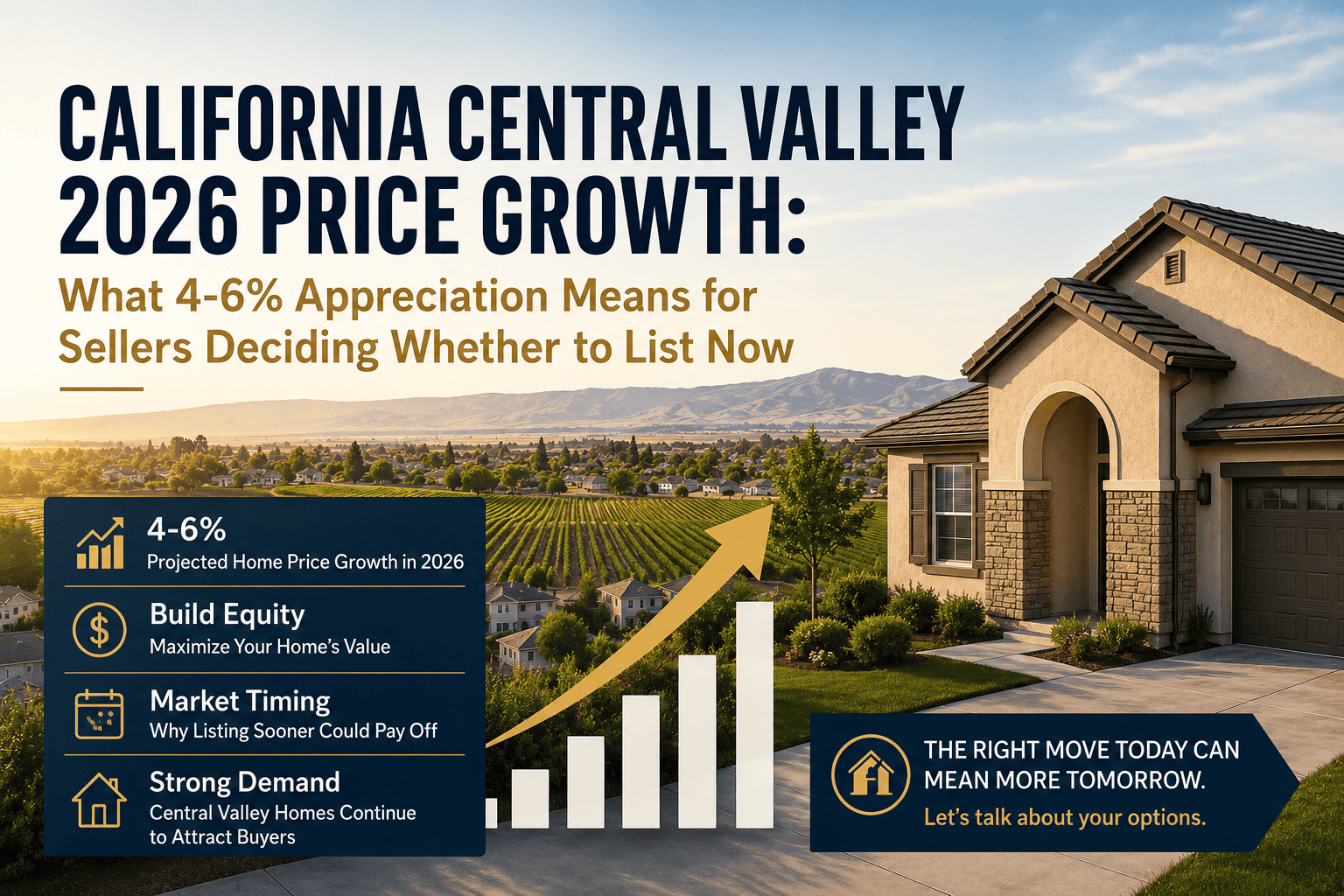
If you’ve been sitting on the fence about listing your house, the numbers coming out of the Central Valley 2026 price growth forecasts are worth a hard look. While coastal California markets like San Francisco and San Diego are projected to see modest 3-4% appreciation this year, inland regions — the Central Valley included — are forecast to outpace them, with home values climbing an estimated 4-6% in 2026, according to the California Association of REALTORS® and multiple lending industry forecasts.
As a Realtor working the Turlock and Stanislaus County market every day, I’m getting the same question from homeowners on repeat: is now actually a good time to sell, or should I wait? This post breaks down the Central Valley 2026 price growth story, what it means specifically for Turlock and the surrounding communities, and how to think through your own decision if you’re weighing whether to list your home in 2026.
Why the Central Valley Is Outperforming Coastal Markets in 2026
California’s housing market overall is described by economists as “balancing” in 2026 — home price gains have slowed from the rapid run-ups of prior years, giving buyers and sellers more predictable conditions. But that balance isn’t uniform across the state, which is exactly why the Central Valley 2026 price growth outlook looks so different from what coastal sellers are seeing.
High-cost coastal metros like San Francisco (still above $1 million median) and Los Angeles are expected to see steady but modest 3-4% appreciation, according to JVM Lending’s 2026 market forecast. Inland regions, including the Central Valley and Inland Empire, are forecast to see stronger gains in the 4-6% range, largely because affordability continues to pull buyers away from the coast and into markets like ours.
That affordability gap is showing up in the data. A recent Q2 2026 report from the California Association of REALTORS® found that housing affordability statewide slipped slightly after hitting a four-year high earlier in the year — but the Central Valley remains a relative bright spot for buyers priced out of coastal metros. When buyer demand keeps flowing into a region even as affordability tightens elsewhere, that’s typically a setup for continued Central Valley home appreciation, not a slowdown.
The Big Picture: Statewide Numbers
Zooming out, the California Association of REALTORS® projects existing single-family home sales statewide will reach around 274,400 units in 2026, a 2% increase over 2025, with the statewide median price expected to climb roughly 3.6% to a record $905,000, according to Norada Real Estate’s 2026 forecast. Inland markets like ours are expected to outpace that statewide average — which is exactly why the Central Valley 2026 price growth trend puts sellers here in a stronger position than the headlines about a “cooling market” might suggest.
What This Looks Like in Turlock and Stanislaus County Right Now
Statewide forecasts are useful context, but what actually matters if you own a home is what’s happening on your street. Here’s where the local piece of the Central Valley 2026 price growth story — the Turlock housing market 2026 — stands as of this writing:
- Turlock median home price: Local market reports, including Houzeo’s Turlock housing market data, place Turlock’s median sale price in a range of roughly $367,500 to $499,450 depending on the data source and month sampled — a spread that reflects both seasonal swings and differences in how each platform calculates “median.”
- Days on market: Homes in Turlock have been moving fast — some recent reports show homes going under contract in as few as 9-20 days, well below the pace of many other California markets.
- Months of supply: Inventory sits at roughly 1.67 months of supply in parts of the local market — a tight number that typically favors sellers. For context, 4-6 months of supply is generally considered a balanced market; anything under that tends to put upward pressure on prices, reinforcing the broader Central Valley 2026 price growth forecast.
- Sale-to-list price ratio: Homes have recently been selling at close to 97-98% of asking price, meaning well-priced homes aren’t sitting around waiting for a lowball offer.
Zoom out to Stanislaus County home prices more broadly, and the picture is similar: tight inventory, brisk sales pace, and a market that’s held up better than many predicted given higher rates over the past couple of years, per Redfin’s Stanislaus County market data.
Turlock’s Track Record of Appreciation
This isn’t a one-year story, either. Turlock has been one of the standout performers in the broader Stanislaus County market for several years running, with Mariani Real Estate’s Stanislaus County report showing median sale prices climbing nearly 5% year-over-year in recent stretches — one of the stronger increases among regional peers. That kind of sustained Central Valley home appreciation is part of why inland markets are drawing so much buyer interest from priced-out coastal transplants, and part of why the Central Valley 2026 price growth forecast isn’t just a one-time bump.
What 4-6% Price Growth Actually Means for Your Bottom Line
It’s easy to read “4-6% appreciation” and shrug it off as a rounding error. It isn’t. Here’s what that range of Central Valley 2026 price growth looks like in real dollars on a typical Turlock home:
- On a home valued at $450,000, a 4% gain adds roughly $18,000 in equity over the year.
- On a home valued at $450,000, a 6% gain adds roughly $27,000.
- Combined with whatever equity you’ve already built through your mortgage paydown, that’s a meaningful jump in your net proceeds at closing.
If you’re deciding whether to list my home in 2026 or wait another year, that’s real money to weigh against the carrying costs of staying put — property taxes, insurance, maintenance, and the opportunity cost of equity sitting untapped in a house instead of working for you elsewhere.
Should You List Now, or Wait for More Appreciation?
This is the question I get most, and the honest answer is: it depends on your specific goals, not just the market forecast. Here’s how I walk sellers through the Central Valley 2026 price growth decision.
Reasons to List Sooner Rather Than Later
- Low inventory works in your favor today. With months of supply still under 2 in parts of the local market, competition among buyers is fierce for well-priced listings. That tends to compress in California’s slower fall and winter months, so listing while demand is still strong can mean a faster sale and a better sale-to-list price ratio.
- Waiting for appreciation isn’t free. If you’re banking on another year of 4-6% gains, remember you’re also paying property taxes, insurance, and upkeep the whole time you wait — costs that eat into any paper gains.
- Rates could shift buyer behavior. Mortgage rate movements — even small ones — change what buyers can afford and how urgently they shop. A rate dip could bring a wave of new buyers into the market (good for you, if you’re already listed) or it could bring more competing sellers off the sidelines (less good, if you wait).
- Move-up buyers benefit from both sides. If you’re selling to buy your next home in the same Central Valley real estate forecast area, appreciation on your current home is partially offset by appreciation on what you’re buying next. Selling sooner locks in today’s numbers on both sides of the transaction.
Reasons Some Sellers Choose to Wait
- You need the extra equity to make your next move work. If a few more months (or a full year) of appreciation gets you meaningfully closer to a down payment goal or debt payoff, that math might outweigh the benefits of listing now.
- Your home needs work first. If updates or repairs would meaningfully boost your sale price, it may make sense to invest the time now rather than list as-is.
- Life timing simply doesn’t align yet. Market conditions are one input, but a job change, kids’ school year, or a not-yet-ready next home matter just as much.
There’s no universal right answer here — it’s a conversation, not a formula. If you want to talk through your specific numbers, reach out and I’m happy to run a no-obligation home valuation so you’re deciding with real data instead of guesswork.
How Inland Migration Is Reshaping Central Valley Demand
One underappreciated driver behind the inland California real estate trend is simple: people priced out of the coast are moving inland, and they’re bringing coastal-level urgency to a more affordable market. Population movement — in-migration from higher-cost metros, out-migration where jobs and housing don’t align — is one of the core factors economists point to when explaining regional price divergence within California, and a big reason the Central Valley 2026 price growth forecast keeps beating the statewide average.
For Turlock and greater Stanislaus County, that means a steady pipeline of buyers who see our market as an entry point to homeownership they couldn’t find in the Bay Area or Southern California. As long as that gap in affordability persists, it’s reasonable to expect the Central Valley 2026 price growth trend to keep supporting demand here, even if statewide appreciation cools further.
What This Means If You’re a Buyer, Too
If you’re planning to sell and buy in the same market — which describes a lot of my clients — the best time to sell a house in the Central Valley conversation isn’t just about maximizing your sale price. It’s about your net position after both transactions. A rising market can work in your favor as a seller and work against you as a buyer, since your next home is appreciating too. That’s another reason timing conversations should be personalized rather than based on headlines alone. If you’re weighing your options, our home buyer’s guide walks through financing, timelines, and what to expect in today’s Modesto and Turlock markets.
How Mortgage Rates Factor Into the Central Valley 2026 Price Growth Forecast
No conversation about Central Valley 2026 price growth is complete without talking about rates, because they directly shape how many buyers can afford to compete for your home. Even small moves in mortgage rates change monthly payments enough to push buyers in or out of their target price range.
Here’s the dynamic worth understanding: if rates ease later in 2026, expect two things to happen at once. More buyers regain affordability and jump back into the market, which supports continued price growth. But more sellers who’ve been waiting on the sidelines may also decide to list, which adds inventory and could soften the pace of appreciation. That’s part of why “waiting for the perfect rate environment” is rarely a winning strategy — the conditions that bring buyers back tend to bring competing sellers back too.
For now, Turlock’s tight months-of-supply numbers suggest we haven’t seen that inventory wave yet, which is exactly why current sellers are in a comparatively strong position within the broader Central Valley 2026 price growth story.
Preparing Your Turlock Home to Capture Maximum Appreciation
Forecasted appreciation is a market-wide average — it doesn’t automatically apply evenly to every listing. Homes that are priced right and show well tend to capture the full benefit of a rising market, while homes that are overpriced or need obvious work often sell for less than the “market” number would suggest. A few things I recommend to sellers looking to capture the full upside of the Central Valley 2026 price growth trend in this Turlock housing market 2026 environment:
- Get a professional home valuation before you set a list price. Automated estimates from sites like Zillow or Redfin can be off by tens of thousands of dollars in a market moving as quickly as ours. A local, in-person valuation accounts for your specific street, school zone, and recent comparable sales.
- Handle small repairs before listing, not after an inspection finds them. Buyers in a competitive market are quick to walk from homes with visible deferred maintenance, even when overall demand is strong.
- Time your listing around the local school calendar and seasonal buyer patterns. Spring and early summer historically bring the largest wave of Central Valley buyers, though a tight fall market can still work well for a well-prepared listing.
- Don’t skip staging, even in a seller-friendly market. With days-on-market numbers this low, buyers are moving fast — and they’re comparing your home against others they toured the same weekend.
Frequently Asked Questions About Selling in the Central Valley in 2026
Is the Central Valley really outpacing coastal California in appreciation?
Based on current forecasts, yes. The Central Valley 2026 price growth outlook puts inland regions at 4-6%, compared to roughly 3-4% for high-cost coastal metros like San Francisco and San Diego, largely due to affordability-driven demand shifting inland.
How does Turlock compare to the rest of Stanislaus County?
Turlock has consistently been one of the stronger-performing markets within Stanislaus County, with appreciation and days-on-market numbers that often outperform the broader Modesto real estate market and county-wide averages, according to Nergal Real Estate’s Turlock market breakdown.
Should I wait until spring 2027 to list?
Not necessarily. Current inventory conditions favor sellers right now, and there’s no guarantee spring 2027 will bring better numbers than today — especially if more sellers list at the same time, increasing competition for buyer attention.
What’s the fastest way to know what my home is worth today?
A local home valuation that accounts for recent comparable sales in your specific neighborhood is far more reliable than an online estimate. Reach out, and I can put one together for you.
Central Valley 2026 Price Growth: Key Takeaways for Sellers
- Statewide, California home prices are forecast to rise a modest 3.6% in 2026, but Central Valley 2026 price growth is forecast to outpace that at 4-6%.
- Turlock and Stanislaus County continue to show tight inventory, fast days-on-market, and strong sale-to-list ratios — all signals of a market that still favors well-prepared sellers.
- On a $450,000 home, the difference between 4% and 6% appreciation is roughly $9,000 in additional equity — money worth factoring into your listing timeline.
- Waiting for more appreciation carries real carrying costs; there’s no guarantee next year’s numbers will beat this year’s.
- The right timing depends on your personal goals as much as the market data — a home valuation and a real conversation beats guessing.
Ready to Talk Through Your Options?
Every seller’s situation is different, and the Central Valley 2026 price growth story is only useful if we translate it into what it means for your specific home and your specific goals. If you’re weighing whether to list this year, reach out and I’ll put together a current home valuation so you can make the decision with real numbers, not just headlines.