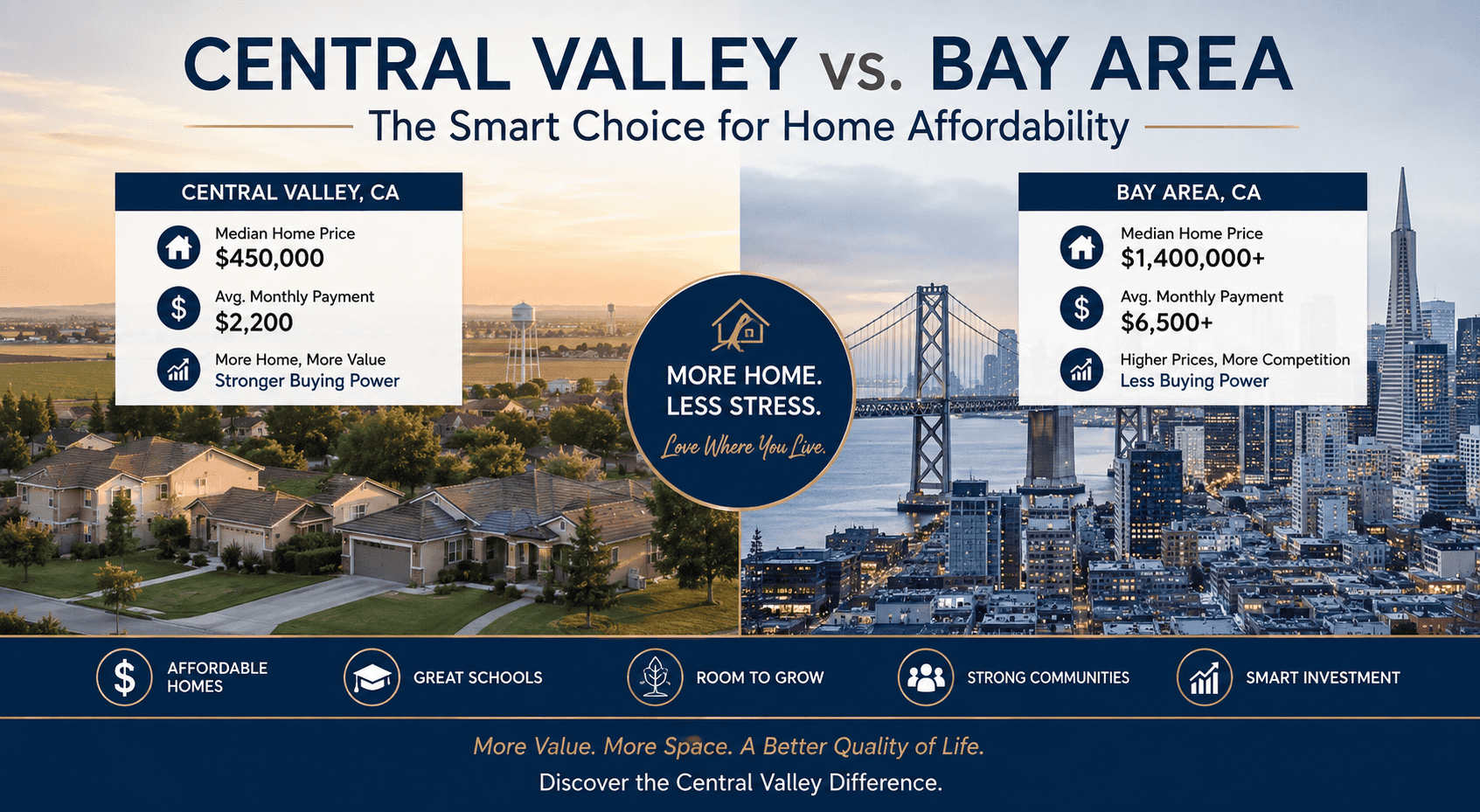
If you’ve spent any time scrolling listings in San Francisco, Oakland, or San Jose lately, you already know the punchline: the numbers don’t work for most working families anymore. That’s exactly why I keep fielding the same phone call, week after week, from Bay Area buyers asking about the Turlock real estate market. They’ve weighed Central Valley Affordability vs. Bay Area pricing, and Turlock keeps winning.
I’ve been helping buyers and sellers navigate Stanislaus County long enough to see this shift go from a trickle to a steady current. It isn’t just about cheaper square footage anymore — it’s Highway 99 access that actually gets you somewhere, a growing university anchoring the local economy, and a lifestyle that doesn’t require a six-figure income just to rent a one-bedroom. Let’s walk through why so many Bay Area households are landing in Turlock, and what it actually looks like once they get here.
Central Valley Affordability vs. Bay Area: The Numbers
Let’s start with the plain arithmetic behind Central Valley Affordability vs. Bay Area pricing, because it’s the reason this conversation exists at all. As of late 2025, the median home sale price in San Francisco sits around $1.4 million, with per-square-foot costs still climbing even as overall price growth has flattened. That’s not a typo — that’s the entry price for an ordinary single-family home in a city where the median household income, while high by national standards, still doesn’t stretch that far once you factor in a mortgage at today’s rates.
Compare that to Turlock, where the Turlock median home price was around $485,000 as of early 2026 — roughly a third of what the same buyer would pay in San Francisco. Homes here are moving fast too, averaging about 26 days on market with only 1.9 months of supply, so it’s not a “cheap because nobody wants it” situation. It’s a seller’s market with genuinely attainable pricing, which is a combination Bay Area buyers haven’t seen in their home counties in over a decade.
This gap isn’t a fluke or a one-year anomaly. The Bay Area to Central Valley migration pattern has been documented by researchers at the California Policy Lab, who found that Central Valley destinations are a consistent landing spot for households leaving the Bay — particularly lower- and middle-income movers who are priced out of coastal counties but still want to stay within a reasonable drive of Bay Area jobs, family, and culture.
What $500K Actually Buys You in Turlock vs. the Bay Area
Numbers on a chart are one thing. What buyers actually feel when they tour homes is another, and it’s usually the moment Central Valley Affordability vs. Bay Area stops being an abstract comparison and starts being the moment the decision gets made.
In the Bay Area, $500,000 might get you a condo, a fixer-upper in an outlying suburb, or — in San Francisco proper — nothing at all as a standalone home. In Turlock, that same budget typically buys a three- or four-bedroom single-family home with a yard, a garage, and often a pool, in a neighborhood built for families rather than density.
I walk clients through this comparison constantly, using Turlock home values side by side with what they’re seeing in their current Bay Area zip code. The difference in square footage per dollar is usually the moment a hesitant buyer stops thinking of Turlock as a compromise and starts thinking of it as an upgrade.
It’s not just about the house itself, either. Larger lots mean actual yard space for kids and pets. Newer subdivisions on the west and north sides of town offer modern floor plans that simply don’t exist at comparable price points closer to the coast. For buyers coming from 900-square-foot apartments, the shift in daily quality of life is often bigger than the shift in price.
Why Highway 99 Access Makes Turlock Work for Bay Area Ties
Central Valley Affordability vs. Bay Area pricing alone doesn’t explain why Turlock specifically — rather than a cheaper but more remote town — keeps winning this comparison. The answer is geography, and specifically Highway 99.
Turlock sits directly on the Highway 99 corridor, which threads through the heart of the Central Valley and connects north to Modesto and Stockton, and south to Merced and Fresno. From Turlock, Highway 99 links up with Interstate 580 and the Altamont Pass route into the Bay Area, putting Bay Area job centers, family visits, and weekend trips within reach without requiring a full relocation of a career.
For buyers who work hybrid schedules — in the office two or three days a week rather than five — this commute to Bay Area from Turlock math has become genuinely workable in a way it wasn’t a decade ago. It’s not a short commute, and I’m always upfront about that with clients. But for someone trading a $4,500/month rent payment for a $2,800 mortgage on a house twice the size, an occasional long drive is a trade many families are happy to make.
Highway 99 also does quieter work locally: it connects Turlock to Modesto, Ceres, and the rest of Stanislaus County’s job base, healthcare systems, and shopping, so buyers aren’t sacrificing convenience even on the days they’re not Bay Area–bound.
CSU Stanislaus: A Growing Economic and Cultural Anchor
One thing that consistently surprises transplants is how much of a “college town” feel Turlock has, thanks to CSU Stanislaus. The university’s main campus sits on 228 acres right here in Turlock and enrolled roughly 9,265 students as of Fall 2024 — a population that supports local restaurants, events, athletics, and a steady base of rental and starter-home demand.
For buyers, CSU Stanislaus matters in a few concrete ways. It anchors local employment (faculty, staff, and the broader services economy that grows up around any university). It brings cultural programming — theater, music, lectures, athletics — that you’d otherwise have to drive into Modesto or the Bay Area for. And it supports property values in surrounding neighborhoods, since university towns tend to have more resilient housing demand than comparably sized cities without an anchor institution.
I regularly point relocating families toward neighborhoods within easy reach of the CSU Stanislaus campus, especially those with school-age kids who may eventually look at the university as an affordable, close-to-home college option of their own down the road.
The Bay Area Exodus Is Real — Here’s the Data
It’s worth being precise here rather than just repeating conventional wisdom about Central Valley Affordability vs. Bay Area trends, because “everyone’s leaving the Bay Area” gets thrown around a lot without numbers behind it.
The California Policy Lab’s research on Bay Area outmigration found that among Bay Area residents who move within California, a meaningful share land in the Central Valley — with lower-income movers relocating there at notably higher rates (around 8%) than higher-income movers (around 5%). That gap tells you something important: this Bay Area exodus isn’t primarily wealthy retirees cashing out equity. It’s working families and first-time buyers who’ve simply run the numbers and found that staying in the Bay Area no longer pencils out.
Local reporting backs this up anecdotally. Realty groups across the Central Valley — from Stanislaus County up through San Joaquin County — have described years of steady, sustained interest from Bay Area buyers, not a short-lived pandemic blip. What changed during the pandemic was remote work normalizing the idea of living farther from the office; what’s kept the trend going since is simply that Bay Area home prices never came back down to earth.
For sellers in Turlock, this matters too. A steady stream of well-qualified, motivated Bay Area buyers has helped keep local demand strong even as national headlines describe a cooling market elsewhere. If you’re weighing selling your home in Turlock, this buyer pool is part of why local inventory moves as quickly as it does.
Mortgage Rates in 2026: How Far Your Money Goes in Turlock
Rates are part of every conversation right now, so let’s address them directly. As of mid-August 2026, the average 30-year mortgage rate sits around 6.71%, essentially flat to slightly lower than earlier in the summer as inflation has cooled and the labor market has softened.
That rate applies whether you’re buying in San Francisco or Turlock — but the impact on your monthly payment is worlds apart. On a $1.4 million San Francisco purchase, that rate translates into a principal-and-interest payment north of $7,200/month before taxes and insurance. On a $485,000 Turlock purchase, the same rate produces a payment closer to $2,500/month. That’s not a marginal difference; it’s the difference between a payment that requires a dual six-figure household income and one that a single median-income earner in Stanislaus County can realistically carry.
This is exactly why so many buyers I work with are less focused on chasing the lowest possible rate and more focused on the underlying Central Valley Affordability vs. Bay Area fundamentals, and the broader Central Valley housing market 2026 trends — where even at today’s rates, the math simply works better here than it does on the coast.
Turlock Cost of Living: The Fuller Central Valley Affordability vs. Bay Area Picture
Housing is the headline, but it’s worth zooming out to the full Central Valley Affordability vs. Bay Area cost-of-living picture, because that’s what actually determines whether a move pencils out long-term.
By the numbers, Turlock’s overall cost of living index sits around 130, compared to a national baseline of 100 — meaning it runs about 30% above the U.S. average, driven almost entirely by housing costs, which sit 62% above the national norm. That sounds high in isolation. But measured against California as a whole, where the statewide cost of living index runs around 141, Turlock is actually about 7% cheaper than the state average, and dramatically cheaper than San Francisco, San Jose, or Oakland specifically, where housing costs alone can run three to four times the national baseline.
In other words: Turlock isn’t a “cheap” town by national standards, but it’s meaningfully more affordable than California’s coastal metros, and every dollar you’re not spending on rent or a mortgage payment goes further here on groceries, gas, childcare, and everyday life than it would anywhere near the Bay.
Local Incomes and the Affordability Gap That Actually Matters
There’s one more number worth putting next to the housing figures: local income. As of the most recent Census data (updated May 2026), the median household income in Stanislaus County is roughly $81,468.
Run that income against a $485,000 median Turlock home and a 6.71% mortgage rate, and a median-earning local household lands in a genuinely sustainable homeownership range — something that’s simply not true for a median earner trying to buy in San Francisco or San Jose, no matter how high Bay Area salaries skew on paper. This is the real affordability gap: it’s not just that homes cost less here, it’s that local incomes and local home prices are actually in proportion to each other, which is increasingly rare anywhere in California.
Schools and Family Life in Turlock
For buyers relocating with kids, schools are usually the first question right after price. Turlock is served primarily by the Turlock Unified School District, which includes a mix of elementary, middle, and high schools across the city, along with strong participation in agricultural and career-technical programs that reflect the region’s Central Valley roots.
I always encourage relocating families to research specific school boundaries before choosing a neighborhood, since ratings and program offerings vary block by block, just like anywhere. But broadly, Turlock families get access to smaller class sizes and a lower cost of private and extracurricular activities than comparable Bay Area districts, on top of the housing savings.
What About the ACE Train? Rail Access Update for Commuters
Buyers often ask me about rail as an alternative to the Highway 99 and I-580 drive, so I want to give an honest, current answer rather than an outdated one.
The ACE train Turlock extension — which would bring Altamont Corridor Express service south from Stockton through Modesto, Ceres, Turlock, and eventually Merced — has been delayed repeatedly. Originally targeted for 2023, then pushed to late 2026, current cost overruns (construction estimates now exceed available funding by roughly $250 million) mean local officials are cautioning it may still be several years out.
In the meantime, connections to existing ACE, Amtrak, and BART service run through Stanislaus Regional Transit connector routes into Modesto and Stockton, where riders can catch the existing ACE line into the South Bay. It’s not a door-to-door solution yet, but it’s a real option for commuters willing to combine a short drive with a train ride.
My honest advice to buyers: don’t move to Turlock banking on rail transit arriving soon. Move here because Highway 99 and I-580 already make the drive workable, and treat any future ACE extension as a welcome bonus rather than a deciding factor.
Life in Turlock: What Bay Area Transplants Are Actually Finding
Beyond the spreadsheet math behind Central Valley Affordability vs. Bay Area decisions, I hear consistent themes from clients a few months after they’ve settled in.
They talk about actually using their yard — grilling on weekends, letting kids and dogs run around a space that would’ve been unthinkable in their old zip code. They talk about breathing room in the monthly budget that lets them save, travel, or simply stop feeling like every paycheck disappears into rent or a mortgage. And they talk about a slower pace that took some adjustment but that most end up preferring once they’re through the transition.
That said, I’m always straightforward about trade-offs, because a good realtor doesn’t oversell a move. Summers run hot here — Central Valley heat is real, and buyers coming from coastal fog should plan for it. Job options outside remote work or a Highway 99 commute are more limited locally than in the Bay Area, though that’s improving as more companies open Central Valley offices to follow their relocating employees. And amenities like fine dining, major concert venues, or specialty shopping mean a drive to Modesto, Sacramento, or the Bay itself. For most transplants, these are manageable trade-offs against the affordability gain — but I’d rather a buyer know that going in than discover it after closing.
Is Turlock Right for You? Questions to Ask Before You Buy
If you’re weighing this move yourself, here are the questions I walk every relocating buyer through before we start touring homes and running the Central Valley Affordability vs. Bay Area numbers together.
First: how many days a week do you actually need to be in a Bay Area office? If it’s zero to three, Turlock’s Highway 99 access makes the math work. If it’s five, be honest with yourself about whether the commute is sustainable long-term.
Second: what does your current rent or mortgage payment actually buy you, square-foot for square-foot? Most buyers are shocked when we run this comparison side by side using current Stanislaus County homes for sale. If you’re coming from the Bay Area with equity to work with, it’s also worth checking what your current home is worth before you list — that number often changes the entire budget conversation.
Third: are you a first-time home buyer, or are you selling a Bay Area property to fund the move? The strategy — and the financing conversation — looks different depending on which situation you’re in, and it’s worth having that conversation early with a lender who understands cross-market moves.
Frequently Asked Questions: Bay Area to Turlock
Is Turlock actually cheaper than the Bay Area, or just cheaper on paper? It’s cheaper in practice, not just on paper. Once you factor in the full Central Valley Affordability vs. Bay Area picture — housing, taxes, childcare, everyday expenses — Turlock consistently comes out ahead, even though it runs slightly above the national cost-of-living average.
How long is the drive from Turlock to the Bay Area? Depending on traffic and destination, expect roughly 1.5 to 2.5 hours each way via Highway 99 and I-580 through the Altamont Pass. It’s realistic for a hybrid schedule of two to three office days a week, less so for a daily five-day commute — and for most buyers weighing Central Valley Affordability vs. Bay Area trade-offs, that occasional drive is worth it.
Can I still find move-in-ready homes in Turlock’s current market? Yes. Current Stanislaus County homes for sale include a healthy mix of move-in-ready resale homes and newer construction, though with only about 1.9 months of supply, well-priced listings do move quickly.
Is CSU Stanislaus a factor even if I don’t have college-age kids? Absolutely. Beyond the education angle, the university supports local jobs, events, and property values, which benefits every homeowner in Turlock regardless of whether their household has a student on campus.
Final Thoughts: Central Valley Affordability vs. Bay Area
The Central Valley Affordability vs. Bay Area comparison isn’t close anymore, and that gap is exactly why Turlock keeps showing up on relocation searches from San Francisco, Oakland, San Jose, and beyond. Between genuinely attainable Turlock home values, real Highway 99 access to the Bay, a growing university anchoring the local economy, and a steady wave of buyers making the same calculation, this isn’t a trend that’s slowing down.
Whether you’re crunching Central Valley Affordability vs. Bay Area numbers on a first home, weighing a move to fund your kids’ future, or curious what your current Bay Area equity could buy you here, I’d rather walk you through the real math than let you guess. Feel free to reach out and I’ll pull current listings, run the numbers on your specific situation, and help you figure out whether Turlock is the right next chapter for your family.